Choosing between crepe paper and cardstock flowers depends on the look, structure, and purpose of your project. What is the difference between crepe paper and cardstock flowers? The answer begins with texture. Crepe paper has fine ridges and natural stretch. It can be shaped into curved petals, soft folds, and lifelike roses. Cardstock feels smoother and firmer. It creates crisp petals, stable leaves, and clean decorative edges.
Paper-flower designer Lia Griffith has said, “The beauty of paper flowers is that they can be made to last.” Her observation reflects an important practical difference. Crepe flowers often look more organic because their fibers respond to gentle stretching. They suit bouquets, wedding décor, and large botanical designs. Cardstock flowers hold their shape better. They work well for wreaths, gift toppers, party backdrops, and children’s craft projects.
The choice is not always obvious. A beginner may find crepe paper delicate and slightly frustrating. It can tear near narrow petal tips. Cardstock may seem easier, but its stiffness can make natural curves difficult. I have also found that color changes under light. A warm pink crepe rose may look softer than a printed cardstock version.
Consider your hands-on experience. Do you want movement and realism, or clean structure and durability? Try one small flower in each material. Compare the edges, shadows, and bending resistance. The result may challenge your first preference. That is useful. Good design often begins with a small, imperfect test.
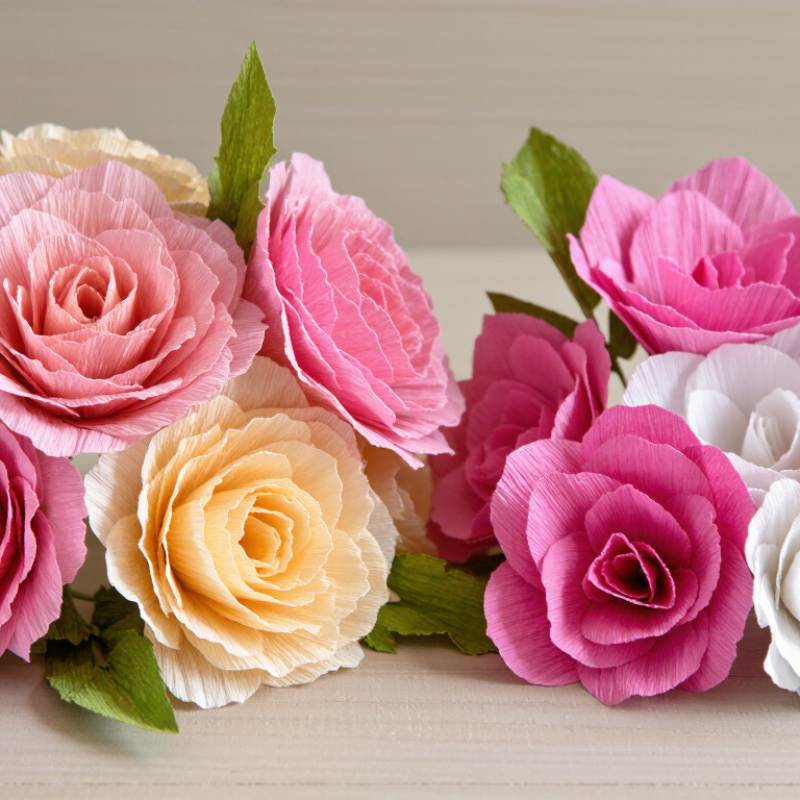
Choosing between crepe paper and cardstock flowers starts with three physical clues: weight, texture, and stretch. Crepe paper is lighter and ridged, with fibers gathered into visible waves. Cardstock feels smoother and holds a firm, even sheet. I test a small strip before cutting petals. This simple check often prevents wasted material.
Weight affects handling more than appearance. Lightweight crepe paper bends around rounded petals and creates soft, natural folds. Heavier crepe paper supports larger blooms, but it may resist tight curves. Cardstock usually has more body, so it suits sharp leaves, folded centers, and structured flowers. A 65–110 lb cardstock range can feel very different, depending on finish and fiber density. Check the actual sheet, not only the number. A thicker sheet is not always easier to shape.
Texture determines the flower’s visual character. Crepe’s grain can suggest veins and gentle shadows, especially when pulled across a petal. Its stretch is its defining advantage. Stretch it lightly for a cupped edge, or too far and the surface may thin unevenly. Cardstock has almost no useful stretch. It scores, bends, and sometimes cracks instead. I once chose cardstock for a tightly curled rose and regretted it; the petals looked stiff. Match the material to the motion: stretch for softness, score for precision, and test one petal before making twenty.
| Comparison Dimension | Crepe Paper | Cardstock | What It Means for Flowers |
|---|---|---|---|
| Basic definition | Paper made with a crinkled, elastic surface created by creping or compressing the sheet. | A smooth, relatively stiff paperboard designed to hold its shape when cut, folded, or layered. | Crepe paper favors organic shaping; cardstock favors clean, structured forms. |
| Typical weight | Approximately 30–180 g/m², with many flower-making sheets falling around 90–180 g/m². | Approximately 180–350 g/m² for common crafting and paper-flower applications. | Lower-weight sheets are easier to shape; higher-weight sheets provide stronger petals and leaves. |
| Surface texture | Visible ridges and a softly wrinkled texture. The ridges usually run in one primary direction. | Generally smooth and more uniform, although some sheets have linen, felt, metallic, or coated finishes. | Creping can resemble natural petal texture; smooth cardstock gives a polished, graphic appearance. |
| Stretch and flexibility | Noticeably flexible across the crepe grain; stretch varies by grade and may range from slight to substantial. | Very little elastic stretch. It bends or creases rather than smoothly expanding. | Crepe can be cupped, gathered, and curved without sharp folds; cardstock is better for defined edges. |
| Grain direction | Important. Stretch is strongest when the sheet is pulled across the visible crepe ridges. | Paper grain affects folding and cracking, but it normally does not provide usable elastic stretch. | Cutting crepe petals in the correct direction improves shaping and reduces tearing. |
| Edge behavior | Edges can be gently stretched, curled, ruffled, or frayed for a softer botanical look. | Edges remain crisp after cutting and can be scored for controlled folds. | Choose crepe for natural-looking petal rims and cardstock for geometric or stylized petals. |
| Shaping method | Shape by stretching, cupping, gathering, twisting, and wrapping around a tool or stem. | Shape by scoring, folding, curling with a tool, layering, and attaching supports. | Crepe needs less scoring; cardstock benefits from templates and precise folds. |
| Dimensional stability | Holds a shaped curve moderately well but may relax or deform if handled repeatedly. | Holds flat planes, folds, and silhouettes more reliably once assembled. | Cardstock is preferable for large flat petals, sturdy leaves, and permanent displays. |
| Resistance to moisture | Usually absorbs moisture readily and can lose strength or shape when wet. | Also water-sensitive, though coated or laminated cardstock can offer greater surface resistance. | Neither material is naturally waterproof; use both indoors or protect them from humidity. |
| Cutting and assembly | Easy to cut, but thin or highly creped sheets may tear during handling or gluing. | Cuts cleanly with a sharp blade; thick sheets may require more cutting pressure. | Use gentle adhesive handling with crepe and a sharp blade for heavy cardstock. |
| Best flower styles | Roses, peonies, poppies, ranunculus, carnations, and other flowers with curved or ruffled petals. | Simple daisies, stylized blooms, geometric flowers, layered wall flowers, and structured foliage. | Match the material to the desired balance of realism, structure, and visual crispness. |
| Recommended choice | Choose it when realistic curves, soft texture, and adjustable petal shaping are the priority. | Choose it when strength, sharp outlines, repeatable templates, and long-lasting structure are the priority. | For complex projects, combining crepe petals with cardstock leaves or support layers can provide both realism and stability. |
Note: Weight, stretch, texture, and durability vary by paper grade, manufacturing process, coating, humidity, and grain direction. The ranges above are typical crafting guidelines rather than universal specifications.
Crepe paper creates soft, flexible petals with natural movement. Cardstock creates firm petals, crisp edges, and stable leaves. Neither material wins every project.
Crepe paper usually suits large roses, peonies, and wall flowers. Stretch the petal center gently. Too much pressure may leave visible wrinkles.
Cardstock works well for daisies, tiny wildflowers, and geometric designs. It holds pointed tips and layered centers. Score it before folding.
Crepe paper commonly ranges from 60 to 180 GSM. Cardstock often ranges from 176 to 300 GSM. Higher GSM usually feels firmer, but weight does not define complete quality.
Choose crepe paper between 60 and 100 GSM for flexible, natural petals. Medium weights support fuller shapes and stronger folds. Test one petal first.
Choose 250–300 GSM cardstock for upright flowers, large structured petals, and firm leaves. It may crease instead of curve near narrow bases. I have ruined petals this way.
Cardstock usually keeps sharper edges in humid conditions, especially above 200 GSM. Neither material is waterproof. Keep both away from rain and excess floral moisture.
Place one drop of water beneath a petal. Wait one minute. Check curling, staining, and softness. This simple test is useful, though not perfectly scientific.
Crepe paper often costs less per sheet. Cardstock may create less cutting waste. Slow shaping can increase labor costs. The cheapest sheet may demand twice the assembly time.
Yes. Use cardstock for the center and crepe paper for outer petals. This adds depth and contrast. Matching colors can be frustrating, though.
What is the difference between crepe paper and cardstock flowers? The main difference lies in weight, texture, flexibility, and structure. Crepe paper typically ranges from 60–180 GSM and has a soft, ridged surface with noticeable stretch, making it suitable for shaping curved petals, ruffles, and natural-looking details. Cardstock is usually heavier, around 176–300 GSM, with a smooth, firm texture that offers stronger support and better shape retention.
Choose crepe paper for large, soft, or highly detailed flowers that require stretching, layering, and gentle molding. Cardstock is better for small to medium flowers, sharp petal designs, sturdy centers, and projects needing clean edges. Your decision should also consider moisture exposure, durability, budget, and crafting technique. Crepe paper provides flexibility and an organic appearance, while cardstock offers stability and a more structured finish. Selecting the right material will help your flowers remain attractive, practical, and suitable for the specific project requirements.

 Arden Decor